
How to Find Cheap Land for Sale Nationwide
Owning land does not have to cost a fortune. Across the United States, you can still find cheap land for sale for a few thousand dollars, and sometimes buy it with as little as $75 down and a small monthly payment. The trick is knowing where to look, what “cheap” really means, and how to avoid the parcels that are cheap for a reason.
This guide covers where land costs the least and 10 proven ways to find cheap land for sale nationwide. It also explains how owner financing works and the red flags to check before you buy.
Quick answer: The cheapest land per acre is usually large rural acreage in the Southwest and Mountain West, in states like New Mexico, Colorado, Texas, and Arizona. To find it, join an off-market land deals newsletter, search land sites for owner-financed parcels, and watch county tax sales and land banks. Always verify access, water, and zoning before you buy.
Want cheap land deals sent to you? The Vacant Land List is a free newsletter with 8,000+ subscribers. It sends off-market vacant land deals nationwide, many seller-financed from $75 down. Join free.
What Counts as “Cheap Land” in 2027?
“Cheap” depends on where you are looking. A $20,000 one-acre lot is a bargain near a growing city but expensive in the high desert. The fairest way to compare land is price per acre: the listing price divided by the number of acres.
For context, the USDA’s latest land values survey put the U.S. average for farm real estate at about $4,500 per acre in 2026, with pasture averaging about $2,000 per acre. In 2025, average farmland values ranged from about $725 an acre in New Mexico to $22,500 in Rhode Island. Pasture in the Mountain states averaged under $1,000 an acre, while pasture in the Southeast averaged more than $5,700 an acre.
So as a rough rule of thumb:
- Under $1,000 per acre is cheap land almost anywhere, and usually means large rural acreage in the West.
- $1,000 to $3,000 per acre is typical for affordable rural land with some access.
- Under $10,000 total is a common budget for small recreational or off-grid parcels.
- Small lots near towns cost far more per acre, but can still be cheap in total price.
Source: USDA National Agricultural Statistics Service, Land Values 2025 Summary, and DTN coverage of the 2026 report.
Where to Find the Cheapest Land in the U.S.
Land is cheapest where there is lots of it, few people, and limited water or services. That is why the Southwest and Mountain West dominate cheap land listings. Here is what asking prices per acre looked like on a sample of real cheap-land listings in 2026:
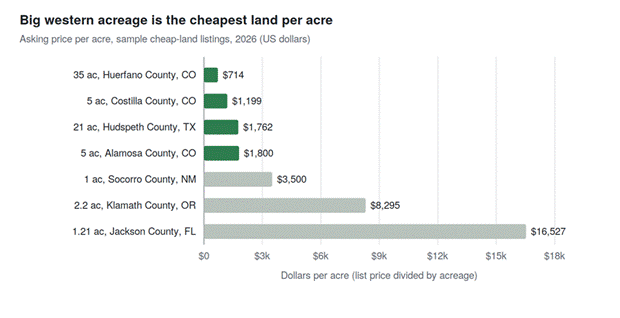
Chart: list price divided by acreage for sample listings on Land.com, LandWatch, and BuyVacantLand.com, 2026. Asking prices, not sale prices.
Notice the pattern: bigger western parcels cost the least per acre, while small lots in the Southeast cost far more per acre even when the total price is low. Neither is “better.” It depends on whether you want space or proximity.
| Region | Why land is cheap | Trade-offs to know |
| Southwest (New Mexico, Arizona, West Texas) | Huge supply of desert acreage, low population | Water can be scarce; long drives to services; heat |
| Southern Colorado (San Luis Valley, Huerfano, Costilla) | Old ranch subdivisions with thousands of 5- to 35-acre parcels | Well rules tied to parcel size; winter access; see our Huerfano County guide |
| Great Plains | Low density and farm-focused land market | Few trees, wind, and limited jobs nearby |
| Rural South and Ozarks | Low taxes and plenty of wooded land | Small lots cost more per acre; check flood zones |
| Pacific Northwest high desert | Remote recreational parcels | Harsh winters; strict septic and building rules |
See cheap land in these areas before it goes public. Deals in the Vacant Land List newsletter include the APN, maps, price, and terms. Browse past issues to see the kind of land we send.
10 Ways to Find Cheap Land for Sale Nationwide
1. Join an off-market land deals newsletter
The fastest way to find cheap land is to have it sent to you. The Vacant Land List is a free Substack newsletter that sends off-market vacant land deals nationwide to more than 8,000 subscribers. Many deals are seller-financed from $75 down, and subscribers see them before they reach public listing sites. Read how the subscription works, then join free.
2. Search land listing sites for owner financing
Big land portals like Land.com, LandWatch, and BuyVacantLand.com have “cheap land” and “owner financed” filters. Sort by price per acre, not total price, and set alerts. Expect competition on the best deals.
3. Buy directly from land investors
Many land investors buy rural parcels in bulk and resell them on simple terms. That is where most $75-down and $99-down deals come from. Compare several sellers and read the terms carefully.
4. Watch county tax sales
When owners stop paying property taxes, counties sell tax liens or tax deeds at auction. Prices can be very low, but rules vary widely by state. Some sales transfer a lien rather than the land, and many come with redemption periods and title issues. Research the rules before you bid.
5. Check land banks and government surplus
Many cities and counties run land banks that sell vacant lots, often with rules about building or maintaining them. For example, the Metro Atlanta Land Bank lists vacant lots for purchase. Federal and state agencies also sell surplus land from time to time.
6. Contact owners directly
Some of the cheapest land never goes up for sale at all. Find a parcel you like, look up the owner in county records, and send a friendly letter. Our step-by-step owner lookup guide shows how.
7. Target tax-delinquent and inherited land
Owners who inherited land they never visit, or who are behind on taxes, are often happy to sell cheap. County delinquent tax lists are public and a great place to start.
8. Look at online land auctions
Online auctions can produce bargains, especially on remote parcels. Read every term, including buyer’s premiums and document fees, which can add up on a small purchase.
9. Drive the area
“For sale by owner” signs on rural roads often never appear online. If you are targeting a specific county, a weekend drive can uncover deals no one else sees.
10. Network with locals
Surveyors, well drillers, title officers, and county staff often hear about land before it is listed. A few friendly conversations can pay off.
How to Buy Cheap Land With $75 Down: Owner Financing Explained
Banks rarely lend on raw land, and when they do, they often want 20% or more down. That is why most cheap land sells for cash or with owner financing (also called seller financing), where the seller acts as the bank. You make a small down payment and pay the seller monthly.
Here is an illustrative example of how a low-down-payment land deal can work:
| Example terms | Amount |
| Price | $6,000 |
| Down payment | $75 |
| Amount financed | $5,925 |
| Interest rate and term | 9% for 60 months |
| Monthly payment | About $123 |
| Total paid over 5 years | About $7,455 |
Illustrative only. Real deals vary. Many sellers offer a lower cash price, and some add a small monthly note fee.
Owner financing makes land ownership possible on almost any budget, but the total cost is usually higher than paying cash. Before you sign, ask:
- When do I get the deed? Getting the deed at closing, with the loan secured by a deed of trust or mortgage, is safer for you than a contract where you get the deed only after the last payment.
- What happens if I miss a payment? Read the default and grace-period terms.
- Are property taxes included in the monthly payment, or billed separately?
- Can I pay it off early without a penalty?
Looking for seller-financed land? Many deals in the Vacant Land List start at $75 down with clear monthly terms. Join free and get the next one in your inbox.
What Cheap Land Can You Buy on Your Budget?
One of the best things about land is that there is something for almost every budget. Here is a rough guide to what buyers commonly find at different price points across the country. Prices vary by state, access, and utilities.
| Budget | What you can often find | Best for |
| Under $5,000 | Small lots or 1- to 5-acre parcels in remote desert or rural subdivisions, often with dirt road access and no utilities | Camping, recreation, and first-time buyers testing the waters |
| $5,000 to $15,000 | 5- to 10-acre parcels in the Southwest and southern Colorado, some with power nearby | Weekend getaways, RV use where allowed, and small off-grid builds |
| $15,000 to $40,000 | 20- to 40-acre tracts, or smaller lots closer to towns | Homesteads, hunting land, and cabins |
| $40,000 and up | Larger acreage, better access, views, or land near growing areas | Primary homes, farms, and long-term investment |
With owner financing, the budget that matters most is often the monthly payment, not the full price. A $10,000 parcel on terms might cost less each month than a phone bill. Just make sure the total cost still makes sense for you.
The Real Costs of Owning Cheap Land
The price tag is only part of the story. Before you buy, budget for these ongoing and one-time costs:
- Property taxes: often low on rural vacant land, sometimes under a few hundred dollars a year, but always check the county’s current bill.
- HOA or POA dues: some rural subdivisions charge annual dues for road maintenance.
- Closing and document fees: many land sellers charge a small document fee, and recording fees vary by county.
- Survey and title: optional on very cheap parcels, but worth it if you plan to build or the boundaries are unclear.
- Access and improvements: a driveway, gate, culvert, well, septic, or solar system can cost far more than the land itself.
- Travel: remote land is cheap partly because it is far away. Factor in the cost of getting there.
Cheap land with low holding costs is one of the most affordable ways to own real estate. Cheap land with high hidden costs is not. Knowing the difference is what makes a good deal.
Why Some Land Is Cheap: Red Flags to Check
Cheap land can be a great deal, or a money pit. Land is often cheap for a reason, so check for these issues before you buy:
| Red flag | Why it matters | How to check |
| No legal access | You may not be able to reach or build on the land | Look for a public road or a recorded easement |
| No water | Wells may be restricted, deep, or not allowed | Check state well rules and nearby well depths |
| Flood zone or wetlands | Building may be limited or insurance costly | Check FEMA flood maps and county GIS |
| Restrictive zoning or HOA | Camping, RVs, or tiny homes may be banned | Read county zoning and recorded covenants |
| Back taxes or liens | Debts can follow the land | Call the county treasurer; order a title search |
| Seller is not the owner | A common land scam | Confirm the owner of record with the county |
| Price far below nearby land | Could signal a scam or serious problem | Compare price per acre with similar parcels |
Avoid land scams: never wire money to a personal account, always confirm the owner with the county, and close through a title company or attorney when you can. Legitimate sellers welcome your questions.
Due Diligence Checklist Before You Buy Cheap Land
Run every parcel through this checklist, whether you found it on our list or anywhere else:
- Verify the APN and owner with the county assessor, and match the acreage and boundaries on the GIS map.
- Confirm access: a public road or recorded easement, and whether you will need a 4×4.
- Check water: well eligibility, nearby well depths, or a hauled-water plan.
- Ask about power and septic: how far away the power lines are, and whether the soil can support a septic system.
- Read zoning and covenants to be sure your plans are allowed.
- Check taxes and liens with the county treasurer and a title search.
- Close properly so the deed is recorded in your name.
For a real-world example of this process, see our Huerfano County, Colorado land buyer’s guide. To look up any parcel’s owner, use our property owner lookup guide.
How the Vacant Land List Helps You Find Cheap Land
Searching for cheap land on your own means hours of scrolling, stale listings, and missing the best deals to faster buyers. The Vacant Land List flips that around. We find off-market land, check the details, and send the best cheap land deals straight to your inbox.
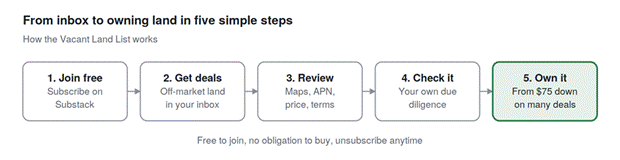
- Off-market deals you won’t find on the big listing sites
- Nationwide parcels, from southern Colorado acreage to rural Texas and beyond
- Seller financing on many deals, from $75 down
- The research done: APN, maps, access notes, price, and terms
- Free to join, with no obligation to buy
Recent cheap land deals from the newsletter
Publisher note: replace these four slots with links to real issues from your Substack archive. Pick your lowest-priced and lowest-down-payment deals, from different states.
Want to see more first? Visit the Vacant Land List homepage, read How It Works, or see land for sale.
Get Cheap Land Deals in Your Inbox Free →
Frequently Asked Questions About Cheap Land for Sale
Where is the cheapest land for sale in the U.S.?
The cheapest land per acre is usually in the Southwest and Mountain West, including New Mexico, southern Colorado, West Texas, and Arizona. USDA data shows New Mexico had the lowest average farmland value of any state in 2025, at about $725 an acre.
Can I really buy land for $75 down?
Yes. Many owner-financed parcels start with very small down payments, followed by monthly payments. The Vacant Land List regularly features deals from $75 down. Always read the full terms.
How can I find cheap land with owner financing?
Join an off-market land newsletter, filter land listing sites for “owner financing,” and buy directly from land investors who sell on terms.
Is cheap land a good investment?
It can be, especially if you buy at a fair price per acre, keep holding costs low, and choose land with access and a clear use. Cheap land can also be hard to resell, so buy something you would be happy to own long term.
What should I check before buying cheap land?
Check the owner and APN, legal access, water, power, septic, zoning, covenants, back taxes, and title. See the checklist above.
Can I live on cheap land in an RV or tiny home?
It depends on county zoning and any HOA covenants. Some areas allow RVs and tiny homes with permits, while others ban long-term camping. Check the rules before you buy.
Are tax sale properties a good way to get cheap land?
Sometimes, but tax sales are complex. Rules vary by state, some sales only transfer a lien, and title problems are common. Research carefully or work with a professional.
How do I avoid land scams?
Confirm the seller owns the land with the county, never wire money to a personal account, compare prices with similar parcels, and close through a title company or attorney.
Is it better to pay cash or use owner financing for cheap land?
Paying cash usually gets you the lowest total price and a deed right away. Owner financing costs more over time, but it lets you buy with little money down and spread payments out. Many buyers finance first and pay the note off early once they are sure they love the land.
Do I need to see the land before I buy it?
Visiting is always best. If you can’t, use satellite maps, the county GIS parcel viewer, street-level imagery where available, and photos or video from the seller. Many land buyers purchase remotely, but they verify everything with county records first.
What is the Vacant Land List?
The Vacant Land List is a free newsletter on Substack that sends off-market vacant land deals nationwide to more than 8,000 subscribers, many with owner financing from $75 down. Subscribe here.
How often do new cheap land deals come out?
New deals go to subscribers as we find them. The best way to see current inventory is to browse the archive and subscribe.
Start Finding Cheap Land for Sale Today
The best cheap land deals go fast, often within days, and many never reach public listing sites. If you want to own land without a big down payment or a bank loan, the easiest first step is to let the deals come to you.
Join more than 8,000 land buyers on the Vacant Land List and get off-market, affordable land nationwide in your inbox, many with owner financing from $75 down.
Join the Vacant Land List Free →
See Our Discount Area Lots and Land For Sale – FREE!
Non MLS vacant and bare land, list is continually updated.
"*" indicates required fields